
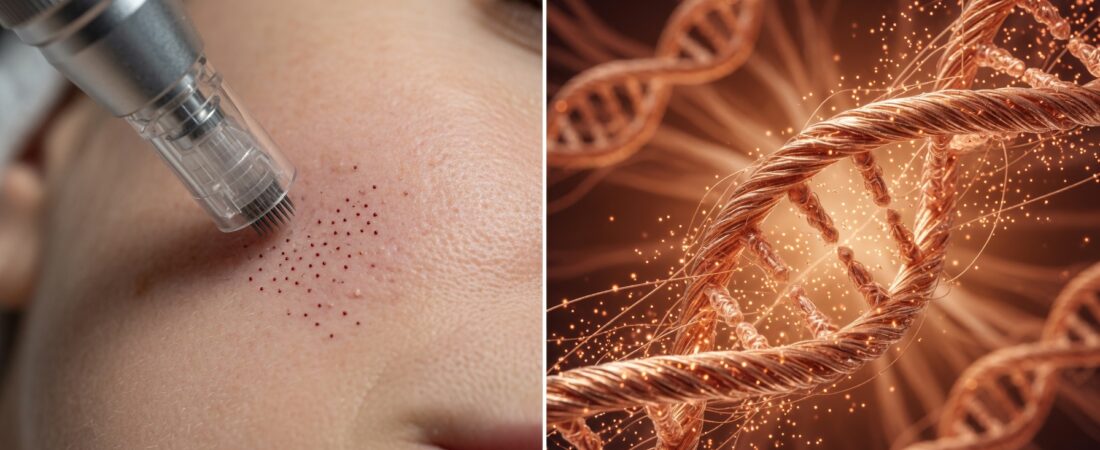
If you’ve had micro-needling done — or you’re considering it — you’ve probably heard the same explanation from your provider: tiny needles create controlled micro-injuries that signal your skin to produce more collagen.
That’s accurate. But there’s a layer of the biology that doesn’t always come up in the consultation chair, and it changes how you might think about what you’re actually doing to your skin.
And it opens the door to a research compound called GHK-Cu — a copper-binding tripeptide with one of the most studied collagen-related research profiles in aesthetic biology.
This article breaks down what’s actually happening under the skin during micro-needling, what the published research on GHK-Cu shows about collagen synthesis, and why some of the most advanced aesthetic researchers are studying these two approaches together.
What Micro-Needling Actually Does at the Cellular Level
Micro-needling — also known as collagen induction therapy — works through a deceptively simple mechanism: physical disruption of the skin’s surface.
When the device passes over your skin, the fine needles create thousands of micro-channels through the epidermis into the upper dermis. At this depth, they do two things simultaneously:
1. Damage dermal fibroblasts — the cells responsible for producing collagen, elastin, and the extracellular matrix that gives skin its structural integrity.
2. Disrupt existing collagen fibers — triggering a wound-healing cascade that treats the disrupted tissue as something in need of repair.
Here’s where it gets interesting. Your skin doesn’t just respond to the physical injury. It responds to a chemical signal sent out by the damaged cells.
Injured fibroblasts and keratinocytes release cytokines, growth factors, and peptide signals — essentially a biological distress call — that instruct surrounding cells to upregulate collagen production, promote angiogenesis (new blood vessel formation), and begin remodeling the extracellular matrix.
The result, over weeks, is new collagen deposition and tissue reorganization that improves texture, firmness, and the appearance of fine lines and scarring.
But here’s what most clients aren’t told: the quality of that healing response depends on what your skin’s receptor system actually does with those signals — and whether anything is present to amplify or support that biological conversation.
Where GHK-Cu Enters the Picture
GHK-Cu (glycyl-L-histidyl-L-lysine copper complex) is a naturally occurring tripeptide first isolated from human plasma. It’s found in higher concentrations in wound fluid and post-injury tissue — which is not a coincidence.
Research beginning in the 1970s and continuing through modern molecular studies has consistently pointed to GHK-Cu as a signal molecule specifically associated with tissue repair, collagen biology, and dermal remodeling.
What makes it directly relevant to the micro-needling question is what it targets.
GHK-Cu and Collagen Synthesis Pathways
Preclinical studies have demonstrated that GHK-Cu activates fibroblasts and stimulates the synthesis of collagen Types I, III, and VI — the primary structural collagens in skin. These are exactly the collagen types that micro-needling’s wound healing cascade is attempting to rebuild.
Published research from Pickart and colleagues has shown that GHK-Cu upregulates decorin expression — a proteoglycan involved in organizing collagen fiber architecture. Collagen production alone doesn’t give you firmer, more refined skin texture; how those collagen fibers are organized and cross-linked is equally important. GHK-Cu research suggests an influence at that organizational level.
The Receptor Connection
This is the mechanism that ties GHK-Cu most directly to micro-needling’s biology.
Micro-needling creates external disruption — physical injury — that causes the skin’s internal repair receptors to signal for collagen production. Those receptors don’t distinguish between the cause of the disruption; they respond to the disruption itself.
GHK-Cu research indicates that it interacts with cell surface receptors and intracellular signaling pathways involved in collagen gene expression, including pathways associated with TGF-β (transforming growth factor beta), one of the primary growth factors released during the wound healing cascade that micro-needling initiates.
In effect: micro-needling triggers the distress signal. The receptor system activates. GHK-Cu research suggests it may support the downstream biological environment in which those receptors are operating.
Gene Expression Effects
A landmark study by Pickart and Margolina found that GHK-Cu influences a remarkably broad set of genes — upregulating genes associated with collagen production, angiogenesis, and skin repair while downregulating genes associated with inflammation and tissue degradation (including certain matrix metalloproteinases that, when overexpressed, can break down existing collagen).
Research published in Biomolecules (2019) documented that GHK influenced over 4,000 human genes. While this scope of effect is still being studied and understood, the core theme across the literature — tissue repair, collagen biology, and anti-inflammatory signaling — is consistent with what you want to support in the post-micro-needling recovery window.
What the Research Doesn’t Say (And Why That Matters)
It’s worth being direct about the limits of what we know.
The research on GHK-Cu is predominantly preclinical — meaning cell culture studies and animal models. The compound hasn’t gone through the large-scale randomized clinical trials that FDA-approved drugs require before making specific efficacy claims.
What the published literature supports is a research profile — a body of evidence suggesting specific mechanisms of action in skin biology that are relevant to collagen synthesis and tissue repair. Researchers continue to study how that profile translates in applied settings.
GHK-Cu is not a treatment. It’s a research compound available for laboratory research use only.
What the science does offer is a mechanistic rationale for why the intersection of physical collagen stimulation (micro-needling) and peptide biology (GHK-Cu’s collagen signaling research profile) is an area worth studying closely — and why researchers and advanced aesthetic professionals are paying attention.
Two Levels of Research Compounds
For those who are interested in exploring the research literature further, there are two tiers of approach that appear in the published science:
Standard research approach: GHK-Cu as a standalone compound, studied for its individual collagen synthesis and tissue repair effects. Available as a research-grade compound (50mg) through brands like Hello Stacks and Stack One — both sourced for research purposes only.
Advanced research stack: GHK-Cu in combination with BPC-157 and TB-500 (Thymosin Beta-4) — three compounds with overlapping but distinct tissue repair and repair research profiles. Hello Stacks offers this as a pre-formulated research stack (GHK-Cu + BPC-157 + TB-500, 70mg total). Researchers studying aesthetic recovery are increasingly looking at multi-compound approaches that may address different aspects of the repair biology simultaneously.
Both approaches reflect a tiered model of research depth — starting simple and building toward more comprehensive compound profiles as the research base expands.
What to Take Away From the Research
If you’re someone who gets micro-needling regularly — or works at a clinic that offers it — the relevant science here comes down to a few core points:
Micro-needling works by triggering the skin’s internal repair signaling through external physical disruption. The quality of the healing response depends on the downstream biology that follows. GHK-Cu has one of the most studied collagen-related research profiles of any peptide compound in the skin biology literature — with specific evidence pointing to fibroblast activation, collagen synthesis, extracellular matrix organization, and gene expression patterns relevant to tissue repair. The intersection of physical collagen induction and copper peptide biology is an active area of research interest — one that’s moving from preclinical literature into the broader conversation happening in aesthetic and regenerative medicine.
Any compounds used in this context are for research purposes only. The information here is intended to help you understand the published science, not to recommend specific protocols.
Going Deeper
If you want to explore the broader research on GHK-Cu, our deep dive on the compound’s mechanism and literature is here: GHK-Cu: The Copper Peptide in Skin, Wound Healing, and Anti-Aging Research
All compounds discussed in this article are for research use only. They have not been evaluated by the FDA and are not intended to diagnose, treat, cure, or prevent any disease or condition. Nothing in this article constitutes medical advice. Consult a qualified healthcare professional before making any health-related decisions.
Free Peptide Research Guide 2026/2027
Download our comprehensive research guide — evidence-based peptide science insights for healthcare practitioners and researchers.