
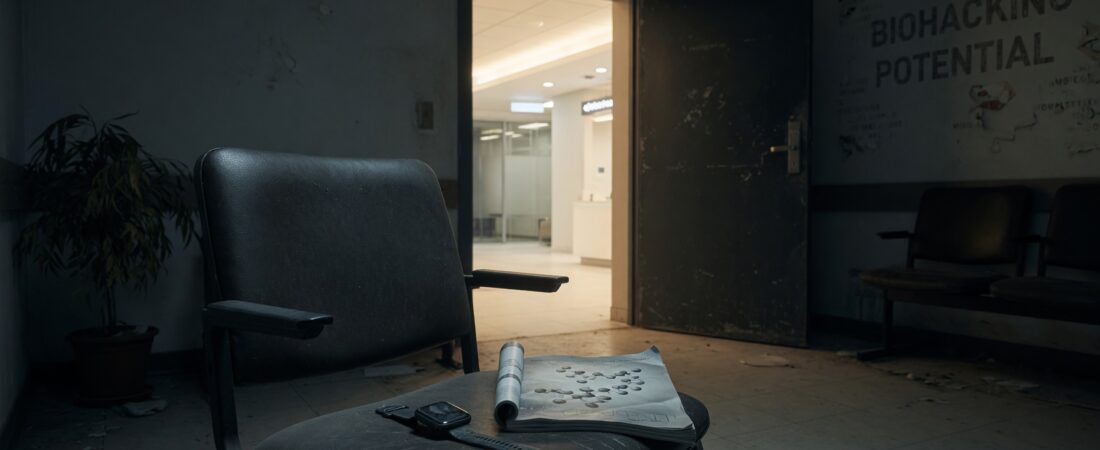
You don’t have to do anything differently.
Your clinic is running well. Your clients are happy. Your service menu is solid. You’ve built something real, and the pressure to chase every new trend can feel like noise.
This is the most dangerous moment for a clinic owner. Not because anything is visibly wrong — but because the shift happening underneath the market is invisible until it suddenly isn’t.
Let’s talk about what happens to the clinics that wait too long.
Free Peptide Research Guide 2026/2027
Download our comprehensive research guide — evidence-based peptide science insights for healthcare practitioners and researchers.
The Patient Who Left Without Telling You Why
There’s a specific type of client you may have already lost and don’t know it.
They were good clients. They paid. They didn’t complain. They came in for micro-needling, maybe a facial, occasionally an IV. And then they stopped coming — not because anything went wrong, but because they found somewhere else. Somewhere that had a different conversation with them. Somewhere that knew what GHK-Cu was when they asked.
They didn’t leave a bad review. They didn’t tell you they were leaving. They just redirected their $3,000–$6,000 annual wellness spend to a practice that spoke their language — and brought three of their friends with them.
This is not a hypothetical. This is already happening in your market.
How the Biohacking Market Got Here — and Why It Keeps Growing
To understand the stakes, you need to understand the trajectory.
The self-directed health movement has been building for years, but it hit an inflection point during COVID. When institutions that were supposed to be trusted sources of health guidance repeatedly shifted positions, suppressed dissenting views, and failed to acknowledge documented errors, millions of people didn’t give up on health — they gave up on the system and started doing their own research.
The podcast economy supercharged this. Andrew Huberman’s show reached tens of millions of listeners discussing neuroscience, peptides, and optimization protocols. Peter Attia built an audience of hundreds of thousands around longevity medicine and the failure of conventional preventive care. Bryan Johnson’s billion-dollar personal experiment in biological age reversal became mainstream news. Joe Rogan gave platforms to doctors the mainstream medical establishment tried to suppress — and those doctors’ audiences exploded.
This isn’t a niche. The global wellness market is estimated at over $5 trillion. The biohacking segment alone has been tracking double-digit annual growth. The patients driving that growth are not the ones who book a facial twice a year. They’re the ones who book a consultation, ask detailed questions, and — if they find a practice that can answer them — become among the most loyal and highest-value clients in the industry.
The Competitor Who Is Watching This Happen
Here’s the uncomfortable part: while some clinic owners are still deciding whether this is worth their attention, a growing number are already moving.
The med spa across town that added a “Research Protocols” tier to their menu is now showing up in the Google results your biohacking patients are using. The wellness clinic two zip codes away that trained their staff on peptide research conversations is getting the referrals from the local biohacking Facebook group. The weight loss clinic that positioned itself around GLP-1 management plus body composition research — including CJC-1295 and BPC-157 protocols — is retaining patients that every competing clinic is losing to the “what do I do about Ozempic face and Ozempic butt” anxiety cycle.
First-mover advantage in patient acquisition is real in local healthcare markets. Patients are creatures of habit. Once they find a practice they trust, they stay. Once they refer their network, that network stays. The clinic that establishes itself as the research-forward option in your market earns a positioning advantage that is genuinely hard to dislodge.
What Failure Actually Looks Like
It doesn’t look like a crisis. That’s what makes it dangerous.
It looks like a gradual softening of your best client retention numbers. It looks like new patient acquisition staying flat while your competitors grow. It looks like the $250/month biohacking patient — the one who tracks everything, researches everything, and refers constantly — consistently choosing somewhere else.
It looks like your highest-margin clients being replaced by price-sensitive clients who comparison-shop on Groupon. It looks like the conversation at the front desk getting harder, because the patients who were easy to retain (the curious, the committed, the well-funded) have found somewhere they feel better understood.
And eventually, it looks like a competitor in your market who has built a reputation as the go-to practice for the biohacking patient — a reputation that took them 18 months to build and will take you years to overcome if you try to catch up.
That’s the stakes. Not a catastrophe. A slow drift in the wrong direction that compounds over time.
What This Requires From You Is Less Than You Think
The good news: the barrier to entry is lower than it appears.
You don’t need to become a researcher. You need to be research-literate. You don’t need a new facility or a new specialty. You need a two-tier research protocol addition to your existing menu — framed correctly, sourced from credible suppliers, and supported by a patient education conversation that treats these clients like the intelligent adults they are.
The compounds these patients are asking about are available through research-grade suppliers like Hello Stacks and Stack One. The research documentation exists. The patient conversation framework exists. What most clinics are missing is simply the decision to engage — and the sourcing relationship that makes engagement credible.
One thing that can’t wait: the positioning decision. The clinic in your market that gets there first earns the reputation. Reputation is almost impossible to dislodge once it’s established with a community as vocal and connected as biohackers.
The Alternative Ending
There is another version of this story.
In that version, you’re the clinic that got there first. Your practice becomes the reference point in your local biohacking community — the one people mention when someone asks where to go. Your retention numbers with high-value clients become your competitive moat. Your referral engine runs on the most prolific word-of-mouth network in your market: people who research everything and share what they find.
The biohacking patient will find a practice that gets it. They always do. The question is only whether that practice is yours.
Ted Yeh | Hello Stacks & Stack One
ted@hellostacks.com | 725.275.7267
If you’re ready to have this conversation — sourcing, service design, patient education framework — reach out. The Med Spa Peptide Protocol Research Guide is coming. Contact Ted to be first.
All compounds referenced are for research use only. Not FDA-approved for any condition. Nothing here constitutes medical or clinical advice.