
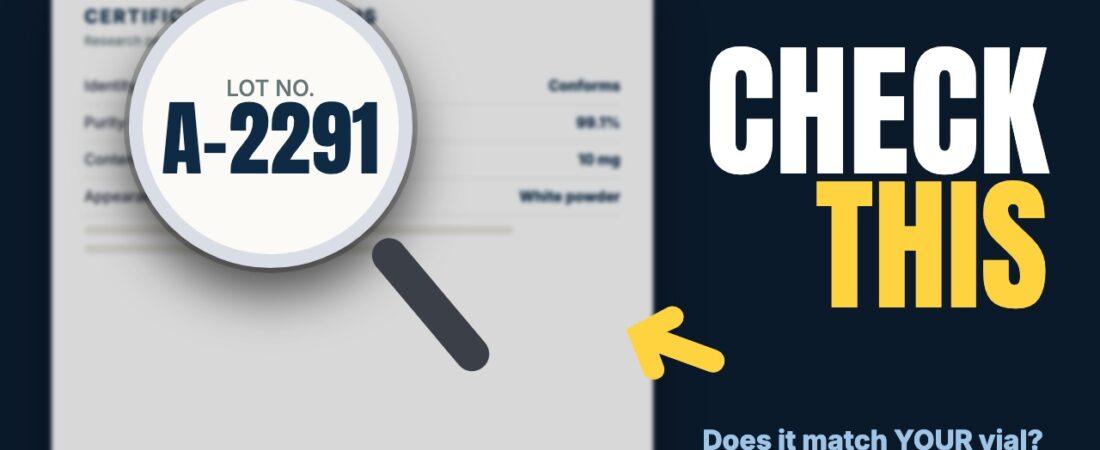
Your supplier sent a certificate of analysis. Good. Now look at it the way you’d look at a lab result for a patient: whose result is this, and when was it run?
A COA is a document a lab produces about one specific batch, or lot. That’s the whole point of it. A COA that isn’t tied to the lot sitting in your fridge tells you about some batch. It doesn’t tell you about yours.
What a lot-matched COA is supposed to answer
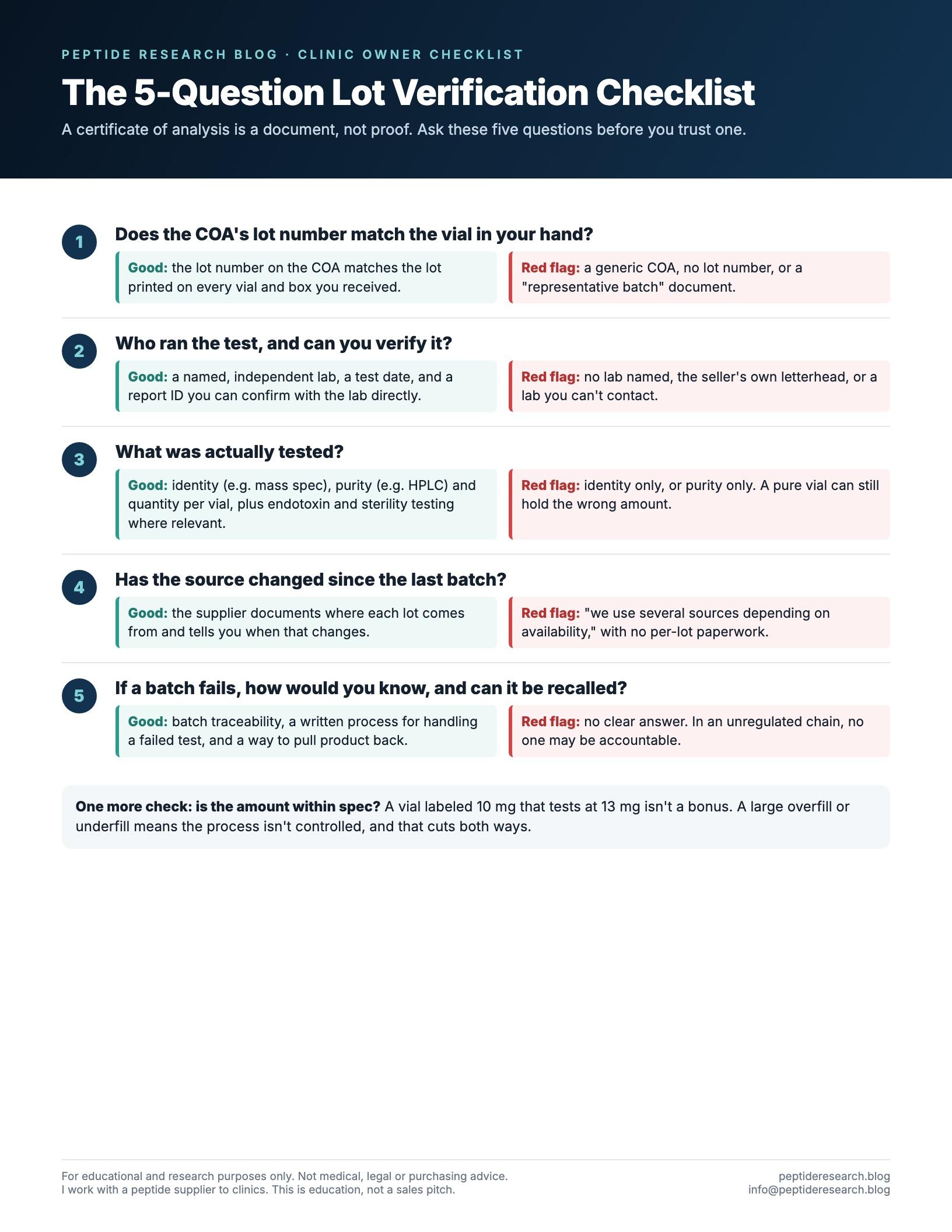
1. Does the amount in the vial match the label? The label states an amount. The COA for that lot should report what was actually measured. If it’s different, in either direction, ask why. My read: people treat “more than the label” as a bonus. I treat it as a sign the fill process isn’t tightly controlled, and I’d want to know what else isn’t.
2. Is what’s in the vial what’s on the label? That’s the identity question, and it’s the most basic thing a COA exists to answer. It only answers it for the lot that was tested.
3. Is this document about this box? A clean, professional-looking COA for a different lot, or a COA with no lot number at all, doesn’t prove anything about the product you received.
The two-minute lot match
- Find the lot (batch) number printed on the vial or box.
- Find the lot number on the COA. They should be identical, character for character.
- Check the product name and stated amount on the COA against the label.
- Check the test date. It should make sense for that lot.
- If any of these don’t line up, or there’s no lot number on the COA, ask your supplier for the COA for your lot before anything is used. A supplier who can document their product shouldn’t find that request unusual.
- Keep the matched COA with your records for that lot.
Myth: “It came with a COA, so it’s been tested.”
A COA tells you a lab tested a batch. Whether that batch is your batch is the question only the lot number answers.
My read
Documentation is the simplest protection an owner has. You’re the one a patient calls if something seems off, so you should be able to put your hand on the right paper for the right lot.
Want the one-page checklist for your team? DM @peptideresearchblog the word COA, or email info@peptideresearch.blog, and tell me what your suppliers send you. Happy to talk it through.
Credit: the “overfill isn’t a bonus” point was sparked by Dr. Ashley Froese’s video on grey-market peptide testing.
I work with a peptide supplier to clinics. This is education, not a sales pitch. Not medical, legal or regulatory advice.