
There’s a moment in the weight loss journey that weight loss clinics aren’t always prepared for: the client hits their goal, the GLP-1 protocol winds down — and they come back six months later with a different set of concerns. The weight is gone. But the skin isn’t where they expected it to be. There’s laxity. Thinning. A textural change that wasn’t in the brochure.
This is not an edge case. For clients losing 15-25% of body weight — which is typical on aggressive GLP-1 protocols — skin changes are a predictable consequence of the biology. The collagen and elastin matrix doesn’t have time to remodel as fast as volume is lost. The fibroblast activity that would normally drive structural recovery is suppressed by age, caloric restriction, and the systemic stress of rapid change.
Weight loss practices that recognize this moment as a service opportunity — rather than an awkward conversation about a referral — are the ones building durable client relationships that extend well past the initial treatment episode.
Free Peptide Research Guide 2026/2027
Download our comprehensive research guide — evidence-based peptide science insights for healthcare practitioners and researchers.
Why Weight Loss Practices Are Uniquely Positioned for This Conversation
Aesthetic practices are typically starting the skin health conversation from scratch. They don’t know the client’s weight loss history, the timeline of their loss, how much they lost, or what their collagen baseline looked like coming in. They’re working from a snapshot.
A weight loss practice adding a skin health tier has the full picture. You know exactly what the client lost, how fast they lost it, what their protocol looked like, how their skin was before — and what the skin changes they’re experiencing are specifically a product of. That longitudinal relationship is a clinical and relational advantage that no aesthetic practice entering the conversation cold can replicate.
The skin health tier isn’t a pivot away from weight loss medicine. It’s the logical extension of it.
The Research Compounds Relevant to Post-Weight-Loss Skin
GHK-Cu: The Collagen Research Foundation
GHK-Cu (copper tripeptide-1) is the most extensively studied compound in aesthetic peptide research. The preclinical literature — decades of in vitro, animal, and early human studies — has investigated its effects on fibroblast activation, collagen Type I and III synthesis, elastin production, and matrix metalloproteinase modulation.
For post-weight-loss skin, the GHK-Cu research rationale is direct: the compound appears to support the cellular machinery — fibroblast proliferation and signaling — that produces new structural proteins. In clients where this machinery has been suppressed by caloric restriction and the demands of rapid body change, the research question of whether GHK-Cu protocol support changes the trajectory of skin structural recovery is substantive and increasingly studied.
Available through Hello Stacks at 50mg for research use only. Also available in the pre-formulated GHK-Cu + BPC-157 + TB-500 stack (70mg) for multi-mechanism recovery research.
BPC-157 and TB-500: The Recovery Stack
BPC-157 and TB-500 extend the skin research protocol beyond collagen signaling into the tissue repair mechanisms that support recovery more broadly. BPC-157’s preclinical research on vascular integrity and VEGF signaling addresses the blood supply environment that healing tissue needs. TB-500’s actin-regulation mechanism supports cellular migration to repair sites. Together with GHK-Cu, they address the recovery cascade more comprehensively than any single compound alone.
For weight loss practices, this stack is the premium research tier for clients with significant skin laxity who want a comprehensive multi-mechanism approach. It’s also the product that creates the most substantive client education conversation — one that matches the research sophistication clients who’ve been managing their weight with clinical rigor tend to bring to follow-up care.
KPV: Barrier and Anti-Inflammatory Support
KPV (Lys-Pro-Val) rounds out the skin health protocol with its anti-inflammatory mechanism. Clients coming off extended caloric restriction frequently present with baseline inflammation levels that affect skin barrier function and healing capacity. KPV’s preclinical research on NF-κB pathway modulation and cytokine regulation addresses this inflammatory context directly — supporting the conditions in which structural recovery can occur.
The Service Architecture
The skin health tier works as a natural post-treatment offering, introduced during the transition conversation as clients approach their weight goal or complete their GLP-1 protocol:
“As you transition off your weight loss protocol, many clients in your position start to focus on the skin health picture — what the research shows about how collagen biology responds to significant weight change, and what protocols are being studied to support structural recovery. We’ve built a research tier around that question specifically for clients coming through our program.”
The structure from there:
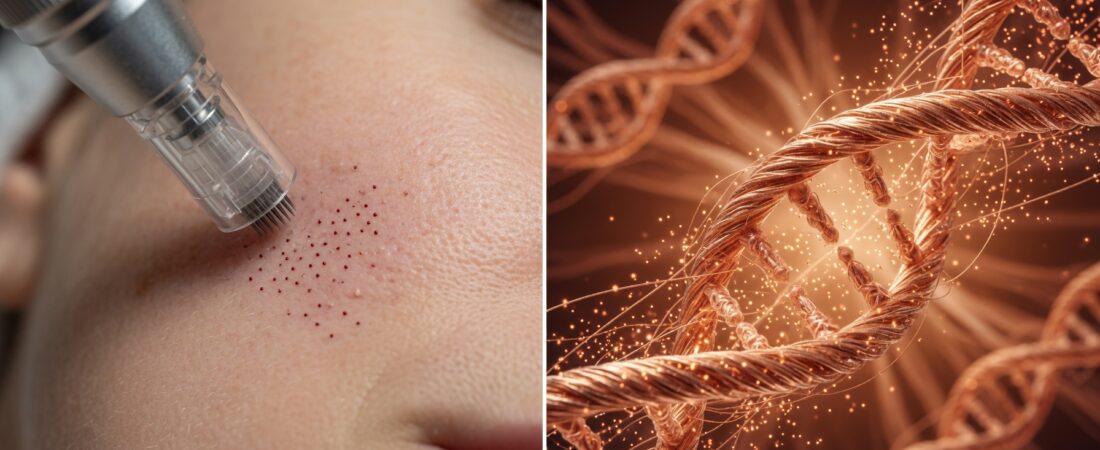
Standard skin research tier: GHK-Cu (50mg) as the collagen signaling foundation, with optional micro-needling protocol for clients who want to combine the post-needling biological window with GHK-Cu timing.
Premium skin research tier: The GHK-Cu + BPC-157 + TB-500 stack (70mg, pre-formulated through Hello Stacks) for clients wanting a comprehensive multi-mechanism approach to skin structural recovery.
Both tiers are presented honestly — as research protocols grounded in preclinical literature, not clinical treatments with guaranteed outcomes. For the research-educated client coming out of a medically supervised weight loss program, that honest framing is not a weakness. It’s the standard they expect.
What This Adds to Your Practice
Beyond the revenue extension, the skin health tier adds something more durable: a reason for the client to stay in your practice after their primary weight loss goal is achieved. Without it, weight loss practices face an inherent churn problem — successful clients leave because they’ve succeeded. The skin health tier converts that success into the beginning of a new research relationship.
It also positions your practice differently in referral conversations. A weight loss clinic that can address the skin consequences of significant weight loss — with the same research rigor it applied to the weight loss itself — is a different kind of partner for clients navigating the full body composition journey.
Want to discuss building a skin health protocol tier into your weight loss practice? Reach out to Ted at 725.275.7267 | hellostacks.com | stackone.com
All compounds referenced are for research use only. Not FDA-approved for any clinical application. Nothing here constitutes medical or clinical advice. Consult qualified professionals before implementing any protocol in a clinical setting.