
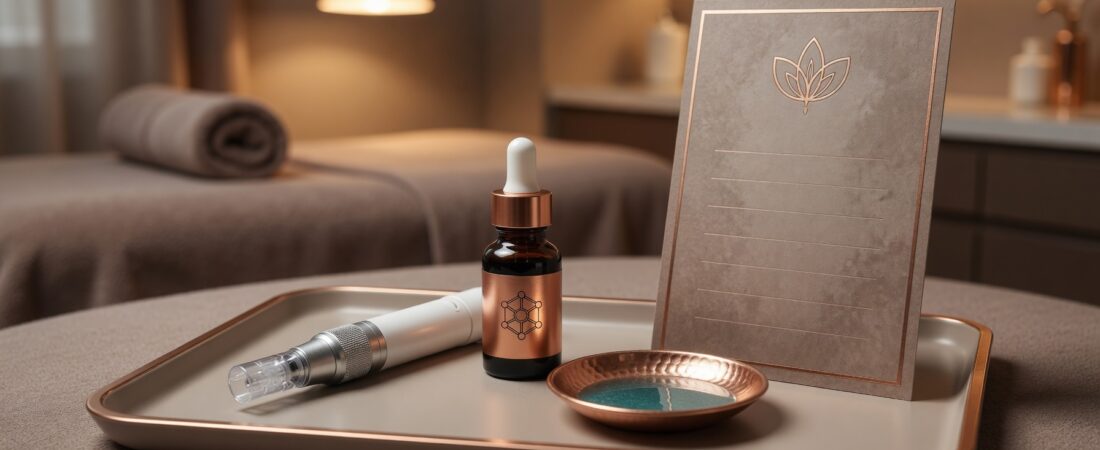
If you’re running a med spa or aesthetic clinic and offering micro-needling, you already understand the service. You know the mechanism — controlled micro-injury triggers the skin’s collagen production cascade. You know the results it delivers. And you know it’s one of your most requested treatments.
What many clinic owners are less aware of is the research that’s building around what happens in the window between the procedure and the visible result — and what that research suggests about a companion protocol that could both improve the patient experience and meaningfully differentiate your practice.
The compound is GHK-Cu. And the case for it, from a service design standpoint, comes directly from its research profile.
The Science Your Patients Are Already Starting to Ask About
GHK-Cu (glycyl-L-histidyl-L-lysine copper complex) is a naturally occurring tripeptide that’s been studied for over 50 years in the context of skin biology, wound healing, and collagen synthesis.
Here’s why it matters specifically to micro-needling:
Micro-needling works by creating physical disruption — external damage to the skin’s surface that signals the body’s internal repair receptors to produce new collagen. The procedure initiates the signaling cascade. What happens with that cascade depends on the biological environment your patient’s skin is in at that moment.
GHK-Cu research has documented specific effects on the collagen production machinery: fibroblast activation, upregulation of collagen Types I, III, and VI, influence over matrix metalloproteinase activity (the enzymes responsible for collagen degradation), and gene expression patterns associated with tissue repair and remodeling.
The mechanistic alignment is direct. Micro-needling triggers the external disruption that signals the receptors. GHK-Cu research shows interactions with exactly the downstream pathways those receptors are trying to activate.
Patients who are doing their research — and more of them are — are already reading this literature. They’re asking questions at the front desk. Some are sourcing compounds on their own without any guidance. The clinic that gets ahead of this conversation is the clinic that earns the trust.
Why This Creates a Service Differentiation Opportunity
The aesthetic market is increasingly crowded. Your clients have options — often within a few blocks. What creates retention and premium positioning isn’t the treatment itself (your competitors offer micro-needling too). It’s the depth of expertise you bring to the conversation around the treatment.
Adding a peptide research protocol to your micro-needling menu does several things at once:
It signals expertise. A practitioner who can speak to the collagen signaling research behind GHK-Cu is operating at a different level of sophistication than one who can only describe the needling device.
It gives clients a meaningful choice. Rather than a binary yes/no on a single service, you’re now offering a tier of depth — the standard treatment vs. the enhanced research protocol. Clients who are serious about their results, who are already reading about peptides, who are the kind of patients that drive your retention and referrals — they will choose up. Every time.
It separates you from commodity providers. When every clinic in your market is offering the same micro-needling treatment at similar price points, the practice that adds a scientifically grounded enhancement protocol has a story to tell that the competition cannot easily replicate overnight.
The Two-Tier Research Model in Practice
The most practical way to integrate this into your menu is through a tiered structure — and the research compounds available through sourcing partners like Hello Stacks and Stack One make this straightforward:
Standard tier: GHK-Cu (50mg) as a standalone research protocol. For clients who are cost-conscious or new to peptide research. The entry point into a conversation that keeps them coming back.
Premium tier: The GHK-Cu + BPC-157 + TB-500 research stack (70mg combined). Three compounds with complementary but distinct research profiles:
- GHK-Cu for collagen synthesis signaling and fibroblast activation
- BPC-157 for tissue repair, angiogenesis, and anti-inflammatory biology
- TB-500 (Thymosin Beta-4) for cell migration, tissue regeneration, and actin-binding research
This combination, available as a pre-formulated research stack, is what the most advanced research protocols in aesthetic biology are beginning to study. It’s also what your highest-value clients — the ones who research everything before they commit — are going to want to know you’re informed about.
The two-tier model works because it never forces a choice. Every client is presented with both options and the science behind each. That transparency is itself a differentiator. It communicates that you’re not upselling — you’re educating. The client makes the call. High-end clientele respond to that approach. It’s why they come to a premium practice in the first place.
What to Know Before Adding Research Protocols
A few things worth keeping in mind as you think through implementation:
These are research-use-only compounds. GHK-Cu, BPC-157, and TB-500 are not FDA-approved treatments. They’re research compounds available for laboratory and research purposes. Any protocol you build around them needs to be framed accordingly — as part of a research-informed conversation, not as a therapeutic claim.
Your clients are asking anyway. The question isn’t whether peptide research is entering the aesthetic conversation — it already has. The question is whether you’re positioned as the informed guide in that conversation, or whether your clients are piecing it together from Reddit threads and YouTube videos.
Sourcing matters. Research-grade compounds require third-party testing, verifiable Certificates of Analysis, and transparent purity documentation. Hello Stacks and Stack One operate at 99%+ purity standards with full COA documentation and research-only framing. That’s the baseline for a practice that takes its reputation seriously.
What I Help Clinics With
If you’re running a med spa, wellness center, or aesthetic practice and you want to understand how to build a peptide research conversation into your patient experience — the sourcing, the framing, the two-tier service model, and how to educate your staff on what the research actually says — that’s exactly what I do.
I’m Ted Yeh, Las Vegas representative for Hello Stacks and Stack One. I work with practices to help them think through how to integrate research-grade peptide protocols into their existing service menu, how to position the conversation with clients, and how to build the kind of educational credibility that retains high-value patients.
You can reach me directly: ted@hellostacks.com | 725.275.7267
Further Reading
For the patient-facing version of this science — an article you can share with clients who are asking questions: GHK-Cu and Micro-Needling: What the Collagen Research Actually Shows
For the full research profile of GHK-Cu: GHK-Cu: The Copper Peptide in Skin, Wound Healing, and Anti-Aging Research
All compounds referenced in this article are for research use only. Nothing in this article constitutes medical or clinical advice. Research compounds discussed are not FDA-approved treatments. Always consult qualified medical and legal professionals before implementing any protocol in a clinical setting.
Free Peptide Research Guide 2026/2027
Download our comprehensive research guide — evidence-based peptide science insights for healthcare practitioners and researchers.