
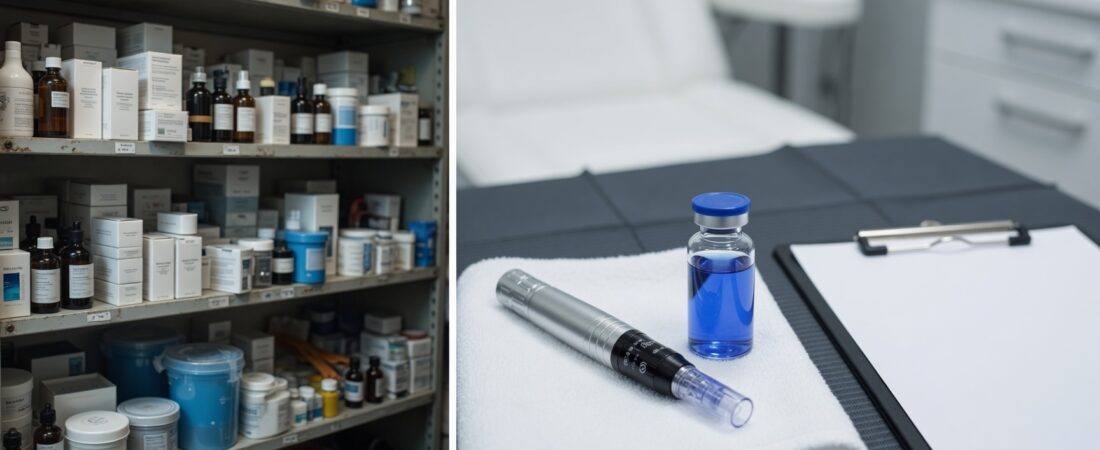
If you’re running a beauty spa, med spa, or aesthetic clinic and your email brought you here — this page is built for you. Below is every piece of peptide research on this blog that’s directly relevant to skin-focused practices: GHK-Cu, collagen research, micro-needling protocols, aesthetic recovery stacks, and the business case for adding a peptide research tier to your service menu.
All content on this blog covers research use only compounds. Nothing here is medical advice, treatment guidance, or clinical recommendation. These are summaries of scientific literature for educational purposes.
Free Peptide Research Guide 2026/2027
Download our comprehensive research guide — evidence-based peptide science insights for healthcare practitioners and researchers.
GHK-Cu: The Core Skin Peptide for Aesthetic Clinics
GHK-Cu (copper peptide) is the most studied topical peptide in the aesthetic research space. If your practice offers micro-needling, collagen induction, or skin rejuvenation, this is where to start.
- Why GHK-Cu Is the Highest-Value Add-On Your Micro-Needling Menu Doesn’t Have Yet — The clinic owner case: what the research shows, why it pairs with micro-needling, and how to think about protocol structuring.
- GHK-Cu and Micro-Needling: What the Collagen Research Actually Shows — Patient-facing deep dive into the science behind combining copper peptide with collagen induction therapy.
- GHK-Cu: The Copper Peptide in Skin, Wound Healing, and Anti-Aging Research — Full research overview: mechanism of action, published literature, and what 40+ years of study actually shows.
- GHK-Cu + BPC-157 Stack: Collagen Synthesis, Skin Repair, and Anti-Aging Research — What researchers have found when studying these two compounds together in skin and wound contexts.
Multi-Compound Aesthetic Research Stacks
Aesthetic recovery involves multiple biological pathways simultaneously. These articles cover what the research shows about combining peptides in skin and procedure-recovery contexts.
- GHK-Cu + BPC-157 + TB-500: What the Research Says About This Aesthetic Recovery Stack — Three-compound research overview for post-procedure recovery biology.
- Four Types of Skin Peptides: Collagen Builders, Barrier Repair, and Beyond — A taxonomy of skin peptides by mechanism: signal peptides, carrier peptides, enzyme-inhibiting peptides, and neurotransmitter-affecting peptides.
- Skin Tightening After Weight Loss: What the Research Says About GHK-Cu and Collagen Recovery — Relevant for practices serving GLP-1 patients who are seeing skin laxity post-weight-loss.
- Melanotan 2 Skin Pigmentation Research: What Aesthetic Clinics Need to Know — Research landscape overview for one of the more controversial pigmentation peptides in aesthetic contexts.
The Ozempic Skin Problem: What Beauty Spas Need to Know
GLP-1 patients are arriving at aesthetic clinics with new concerns. These articles cover what the research shows — and what it means for your service menu.
- Ozempic Face: What Causes It and What Skin and Collagen Research Currently Shows — The biology of facial volume loss from rapid weight loss, and what collagen research suggests about recovery.
- Ozempic Butt: What Rapid Weight Loss Does to Muscle and Tissue — Muscle and tissue loss patterns in GLP-1 patients, and what the body composition research shows.
- How Clinics Can Help Patients Navigate Ozempic Face and Body Composition Changes — The protocol strategy case for practices treating post-GLP-1 aesthetic concerns.
Business Strategy: Building a Peptide Research Tier
These articles address the clinic owner question directly: how do you think about positioning, structuring, and differentiating a research-informed service offering?
- How to Stand Out When Every Spa Offers the Same Menu — Why commodity treatments commoditize practices, and what the research-informed differentiation model looks like.
- The Treatment Room Revenue Problem — And How Research-Grade Protocols Solve It — Fixed cost economics of treatment rooms and the case for high-margin research protocol add-ons.
- The Two-Tier Peptide Research Service Model — How to structure standard vs. premium protocol tiers, and what that means for client acquisition and retention.
- Adding a Skin Health Tier to a Weight Loss Practice — The case for aesthetic add-ons in metabolic medicine practices.
- What “Science-Backed Skincare” Actually Means in 2026 — And Where Peptide Research Fits — How to talk about the research credibly without overclaiming.
- Gut Health, Neurocosmetics, and Longevity Science: What the Mind-Body-Skin Connection Means for Your Treatment Menu — The emerging research conversation aesthetic clinics need to be fluent in.
Recovery Peptides in Aesthetic Research
- Recovery Peptides: BPC-157, TB-500, and GHK-Cu in Research — Overview of the three most studied repair-oriented peptides and what the literature shows about each.
- TB-500: Research on the Thymosin Beta-4 Peptide Fragment and Tissue Repair Biology — Deep dive into TB-500’s wound healing and tissue remodeling research profile.
Have Questions? Want to Learn More About Research Compounds for Your Practice?
This blog is maintained by Ted, a sales representative for Hello Stacks and Stack One — two peptide research brands built specifically for practitioners and researchers who prioritize purity, documentation, and transparent sourcing.
If you’re a clinic owner, med spa operator, or aesthetic practitioner and want to have a direct conversation about research compound sourcing for your practice, reach out here.
All compounds discussed on this blog are sold for Research Use Only. They are not intended for human use, not approved by the FDA for the purposes discussed, and should not be interpreted as medical advice, treatment recommendations, or clinical guidance. All content is for educational purposes based on publicly available scientific literature.